Showing posts with label Kitchen/Cooking. Show all posts

Monday, February 27, 2017

6 Crock-Pot Secrets

I am a busy Mama with a career that allows me to choose where I work. Home is my first choice . . . but that doesn't mean I have extra time for elaborate home cooked meals. I like simple but delicious home cooked meals for my family. That is why I love my crock pot. Here are six sumptuous secrets that I have learned about crock pot cooking.  Bon Appétit!


1. Use fattier meat
Lean meat cooked for a long time-no matter what the temperature-gets tough and stringy. Big hunks of fatty meat like short ribs and pork shoulder work best in a crock pot. The fat will keep the meat moist, and the slow cooking breaks down the connective tissue that makes those types of cuts tough. So with a slow cooker, fatty meat = good. You can always chill and lift the fat off later.

2. Always brown beef on the stove first
Everyone wants a crock-pot recipe where you just toss everything in the pot, then magically have an amazing dinner eight hours later. Unfortunately, it doesn’t work like that. Do not throw beef in raw. Always brown your meat on the stove first- it adds a layer of caramelized flavor you can’t get otherwise.

3. Add ingredients with low notes or sweetness
A low note is a flavor that adds a depth and richness to a dish-like bacon, browned onions, black pepper, and Worcestershire sauce-and they’re integral to any good crock-pot recipe. As are sweet ingredients like brown sugar and tomato paste. Because most flavors break down and become one, those types of strong flavors make a great base for a sauce.

4. Add bright notes, crunchy vegetables, and dairy at the very end
Bright notes are fresh flavors like acid and herbs. They’ll get lost in the mix (and your herbs will turn brown and limp, ew), so it’s better to add those ingredients last. If you want some kind of crunchy vegetable in your dish, it’s also best to add it toward the end to avoid mushy veggies. And dairy? It will curdle, which looks terrible. Stir in any dairy at the very last moment.

5. Take that skin off of the chicken
Do you like rubbery, chewy, gelatinous chicken skin? Then take it off before throwing your bird into the crock pot. Do leave in the bones, though-they’ll help the meat stay tender. And chicken is the magic meat that doesn’t need browning before going into the pot, mostly because it would be cooked too much after a long stint in the slow cooker.

6. Cook things that do not need to hold structure
Macaroni and cheese? Lasagna? Sure, there are slow-cooker recipes for them out there, but you definitely shouldn’t attempt to make them. More often than not, pasta (and other things that should hold their shape) becomes a mushy mess. Just don’t do it.  If you really want a delicious and easy crock pot meal, make something like chili, stew, or soup instead.

Tuesday, November 22, 2011

Peanut Butter Cup & Candy Corn Turkeys (plus a Cookie Pilgrim Hat)

 These little turkeys are perfect for school parties, family nights, and Thanksgiving place holders.  At the end there’s an easy pilgrim hat as well.  I don’t really know where this idea originated -- I made the turkeys as a kid as I’m sure many of you have and I’ve seen the little hats all over the internet.  Both are Turkey Day classics, so go have some fun!

Ingredients/Supplies
Double Stuff Oreo Cookies
Candy Corn
Whoppers
Peanut butter Cups
Chocolate frosting
Yellow Frosting
Optional: Red frosting
Optional: black sprinkles for eyes

*For these kinds of things I love to use the little pre-filled tubes of colored frosting you can buy in the baking isle.  The chocolate is easy to make, and homemade actually works a little better because you can make it stiff.  However for the colored details like yellow and red, these little tubes are great.  It doesn’t really matter what they taste like and they last forever (which is both cool and disturbing at the same time.) I’m using store-bought tubes for everything here purely for convenience- works great!

First step:  Grab a cookie.  You don’t have to put frosting in there, but I like to because it holds in the candy corn a little better. Just give it a little squeeze of chocolate.
Then stuff in your candy-corn.  If you’re in some sort of candy corn shortage, you can cut off the white tips to use later for your beaks.  I think the candy corn sticks in better with the tip so I leave it on.  Go ahead and do all of the cookies through this step.
Next put a dab of frosting on the opposite end of the cookie and secure it to the “base” cookie.  It helps to place them next to a wall as they dry so they stay put.
While those are drying, unwrap your PB cups.  Take a sharp knife and cut a sliver off of one end.  (I don’t need to tell you what to do with the sliver, do I?)  It helps to gently cut in a sawing motion so you don’t break the PB cup.  (Although I wouldn’t have to tell you what to do with a broken one either, would I?)  Cut it from the bottom like I show here:
Once those are ready, flip your cookies over, but you may find it’s easy to keep them next to the wall.  My frosting was a bit soft, so they needed the extra support.
Place a dab of frosting on the pb cup, and place it on the cookie like so:
Now those little guys will need heads, so glue a whopper on there with frosting as well. I put frosting on the side of the whopper that hits both the cookie and the PB cup.  Wouldn’t want a turkey running around with its head cut off, would we??
While they’re still laying there, use a dab of frosting (I use yellow) and glue on the white tip of a candy corn for a beak.  Put two yellow dots on for eyes, and for the black spots in the eyes you can use a dab of chocolate frosting, or a mini chocolate chip, or a little sprinkle like I’ve used.  A sprinkle is really the perfect size if you have them.
Once the beak stays put you can flip them over and draw on some little yellow feet.  If you have red frosting too (usually comes in a set with the tube of yellow) you can add a little wattle.
And there you go, cute as can be!
These make really cute place card holders too, for either a kid, or adult table!  I just made little name tags with Sara's Silhouette and then I popped them in there on toothpicks.
How cute is my little turkey family?
Stick one on each plate and everyone will say “Awwwwwwe….” If you have kids old enough to handle making them, it’s a fun project for them to be in charge of.
They’re also darling combined with pilgrim hats.
Those are just marshmallows dipped in chocolate and placed on a fudge strip cookie.  Use yellow frosting to make the buckle.  (Pretty much the Thanksgiving version of the Halloween witch hats seen in this post!)

Tuesday, May 25, 2010

The 6 Most Unhealthy Foods - Avoid These at All Costs!

Some people swear by the mantra "everything in moderation," but the truth is, some foods, no matter how good they taste, are better off left alone.
If you need a little motivation to stay away from these most unhealthy foods, consider that four of the 10 leading causes of death in the United States are related to diet (diabetes, heart disease, cancer and stroke). And if you're looking to improve yours, cutting back on these six foods is a great place to start. Want to guess first? Read the hints below.

Hints:
#1 is basically liquid candy.
#2 contains acrylamide, a known carcinogen and neurotoxin.
#3 contains nothing more than refined sugar and flour, artificial flavors and partially hydrogenated oil that's loaded with trans fats.
#4 pertains to a store bought version of something . . . it contains high amounts of trans fats and a host of other unsavory additives. Homemade version? A bit better.
#5 has almost 1,000 milligrams of salt in one small serving.
 πππππππππππππππππππππππππππππππππππππππππππππππππππππππππππππππ

Ready for the 6 six things you should delete from your diet?  Did you already guess?

1. Soda.
An average can of soda has 10 teaspoons of sugar, 150 calories, 30 to 55 mg of caffeine, artificial food colors and sulphites. Diet sodas have the even-more-unhealthy artificial sweeteners. A major part of the problem is that sodas have become a staple in many people's diets. A study in the journal Pediatrics found that 56 percent to 85 percent of children consume at least one soft drink a day, and 20 percent of adolescent males drink four or more sodas a day.
"Parents and health officials need to recognize soft drinks for what they are -- liquid candy -- and do everything they can to return those beverages to their former role as an occasional treat," says the Center for Science in the Public Interest (CSPI), a U.S. consumer group. In fact, CSPI has recently petitioned the Food and Drug Administration (FDA) calling for cigarette-style warnings on soft drinks to warn people of their potential health risks (weight gain, diabetes, tooth decay and more).
You knew it was coming ... French fries contain at least two types of cancer-causing compounds.

2. Potato Chips and French Fries.
These popular snack foods contain acrylamide, a known carcinogen and neurotoxin that is formed when foods are baked or fried at high temperatures. "I estimate that acrylamide causes several thousand cancers per year in Americans," said Clark University research professor Dale Hattis.
When CSPI conducted tests on some popular brands of French fries and chips, they found that the acrylamide in a large order of fast food fries was at least 300 times the amount allowed by the Environmental Protection Agency (EPA) in a glass of water.
"There has long been reason for Americans to eat less greasy French fries and snack chips," said CSPI executive director Michael F. Jacobson. "Acrylamide is yet another reason to eat less of those foods."
An Up-and-Coming Absolute Worst Food ... Don't Try This at Home
This one wasn't popular enough to make the top-six list yet, but it's growing in popularity ... and growing fast. The deep-fried Twinkie, first invented in a Brooklyn restaurant by brothers Clint and Rocky Mullen, is making its rounds to country fairs and carnivals around the country.
Here's how they're made:
• Twinkies are chilled, rolled in flour, dipped in tempura batter and fried for a minute or two.
• The frying process melts the cream center, which becomes infused throughout the cake, giving it a pudding-like texture.
• For the finale, they're sprinkled with powdered sugar and served with chocolate or berry sauce.
If you're not into Twinkies, don't despair. The Mullen brothers also sell deep-fried candy bars--Snickers, 3 Musketeers and Milky Way--to suit even the most discerning tastes.
But that's not all. These foods also contain trans fats, the artery-clogging fat that's been linked to raising bad cholesterol (and lowering the good kind), and increasing the risk of heart disease, diabetes, stroke and cancer.
Doughnuts: A somehow tasty concoction of refined sugar, flour, trans fats and artificial flavors with zero nutritional value.
3. Doughnuts.
Tasty, yes. But break a doughnut down and you'll find nothing more than refined sugar and flour, artificial flavors and partially hydrogenated oil that's loaded with trans fats. They have no redeeming qualities whatsoever.
"When it comes to health, the only thing good about them is the hole," said Carla Wolper, nutritionist at the New York Obesity Research Center.

4. Skip the Pre-Packaged Baked Goods 
This category actually includes all varieties of baked goods, including packaged cake and biscuit mixes. What makes these foods so bad is that they almost always contain high amounts of trans fats and a host of other unsavory additives including corn syrup, preservatives and artificial flavors and colors. In fact, commercial baked goods typically contain more trans fats than any other food because not only are they often made with hydrogenated oils, they're fried in them too.
If you're not ready to give up your morning treat just yet, opt for baked goods from your local bakery (which is less likely to use hydrogenated oil for a long shelf-life and is likely to use butter instead of margarine, which typically contains trans fat) or . . . . MAKE THEM YOURSELF!
A hot dog now and then can be reasonably healthy if you seek out a nitrite/nitrate-free variety.

5. Luncheon Meats/Hot Dogs.
Processed meats like these (and others including sausages, bacon, pepperoni and other processed meats) contain a carcinogenic precursor ingredient known as sodium nitrite (sodium nitrate is closely related).
"Sodium nitrite is a dangerous, cancer-causing ingredient that has no place in the human food supply," says nutritionist Mike Adams, author of the Grocery Warning Manual.
And, according to a University of Hawaii study that followed nearly 200,000 people for seven years, people who consumed the most processed meats (hot dogs and sausage) showed a 67 percent increased risk of pancreatic cancer over those who consumed little or no meat products.
Here's some good news: you can find various varieties of nitrite/nitrate-free meats in any health food store.

6. Canned Soup.
Here we're talking about the traditional, canned soups you find in your grocery store. This may come as a surprise, but most canned (and packaged) soups have high levels of trans fats, sodium and artificial preservatives like MSG. Just one cup of canned soup can have almost 1,000 milligrams of salt (and most people eat more than one cup), which is tons considering dietary guidelines recommend consuming no more than 2,400 milligrams for the entire day.
There are healthy options out there, particularly natural, organic brands, but be sure to read the label. The alternative is, of course, to make your own homemade variety.
 __________________________________________________________________________________
Recommended Reading
The Top 8 Foods People Are Most Sensitive To -- Without Even Knowing It!
High Cholesterol? The TOP 12 Non-Drug Strategies to Increase Your HDL Levels

Sources
Original Article

Reuters July 13, 2005
What's Wrong With Trans Fats?
CSPI Newsroom
Doughnuts Get a Big Zero
Organic Consumers Association
CNN: New Junk Food Fad: Deep-Fried Twinkies

Cross posted @ Old Men's Gym  and at  Healthy Mom; Healthy Baby

Thursday, November 5, 2009

What is Kombucha and Does it Bite?

Searching for something that can help energize and rejuvenate you? You cannot come any closer to finding it than in Kombucha (ice) Tea.
It's potent, it's delicious, it improves health, and you can make it yourself!
This tea has been made for over 2000 years so it goes to show you that "everything old is new again!"
It is made using an extraordinary "mushroom" that is placed into a batch of regular sugary tea.

Quick note: A Kombucha mushroom is not a real mushroom, people only call it a mushroom. It is something like a lichen and when grown it looks like a pancake floating on the surface of the tea that it is brewed in. The remarkable tea made from it does not have the flavor of mushrooms. The taste is more like a wine apple-cider and it is delicious.
The tea then begins to ferment and in about 7 days it is ready to drink. During that same 7 day period a second mushroom grows within the tea, this new mushroom is used to make your next batch of tea. Each time you make a batch of tea a new mushroom is produced. Because of this quick reproductive cycle of the Kombucha you can make an endless supply of this incredible tea for free.

Information source:
http://www.kombuchaamerica.com/

A good HOW TO article here.

FAQs from http://www.kombuchaamerica.com/


What is a Kombucha Mushroom?
The Kombucha Mushroom is not a true mushroom but a tea pseudo lichen. It is primarily a fibrous cellulose spongy membrane that is formed by the various Kombucha bacteria and yeast cells that live in the liquid sugary tea. It is primarily grown to act as an evaporation cap to keep the tea from evaporating and also to prevent other microorganisms from getting to the sugary tea. It has no sex, and produces no seeds or spores for the purpose of reproduction but within the cells of the membrane exists the same bacteria and yeasts cells that exist within the tea. When your transfer a newly formed mushroom to a new batch of tea you then introduce these bacteria and yeasts to the new tea which quickly colonize it, cause the tea to ferment, and grow a new membrane on the surface.
Can drinking this tea harm me in any way?

Kombucha tea is safe to drink. The Federal Drug Administration has indicated it is safe provided it is prepared properly. It must be prepared in a clean manner just as any food or beverage you are planning to consume. But like any food, it is possible that the tea can become spoiled. If you drink spoiled tea it might make you ill. But the risk of this happening is no greater than for any other food or beverage. A lot of people pose the safety question about Kombucha because they mistakenly believe it to be a mushroom and they are aware that some mushrooms are poisonous. Kombucha is not a mushroom it is just a cellulose mat.

Is there any relationship between the quality of the tea and the growth size of the new mushroom?
No, not really. Once the tea ferments the size of the mushroom makes no difference. You end the fermentation when you "strain off the tea".

The fermentation of the tea is caused by the living bacteria and yeasts within the tea. The bacteria and yeast is what is responsible for the health benefits of drinking the tea.

Can I eat this mushroom?
Mushrooms can be eaten but not many do so as it is fiberous and may be hard to digest. Also, the only flavor that it has is from the type of liquid tea it which it is grown in. When dried it takes on the appearance of a slippery rubbery leather... chew toy for your dog?
I have heard that if I drink the tea a mushroom will grow in my stomach and kill me, is this true?
Absolutely not!


How soon can I expect to start seeing health benefits from drinking the tea?

Many notice a difference in their health quickly.

What recipe do you recommend to make Kombucha Tea?

Using clean unchlorinated water, not distilled water which lacks mineral content, make a gallon of tea using 8 standard size tea bags of green tea or orange pekoe/black tea.

Add 1 to 1.5 cups of white cane sugar. If you boil the water let it cool to room temperature and add 1/4 cup of apple cider vinegar. The apple cider vinegar is used to lower the pH level of the tea to help the fermentation process and protect against mold formation.

You may also use old Kombucha tea that has turned vinegary in place of apple cider vinegar. Pour the prepared tea into a gallon size glass brewing container with a wide mouth (old glass pickle jars work well)

Add the mother mushroom culture to the tea.

Set the brewing container in a warm area (74F to 84F degrees) out of direct sunlight covered with a paper towel or coffee filter and secured by a rubber band.

Let the tea ferment for 7 to 9 days. Keep in mind that the longer you allow the tea to ferment the more sour it becomes. Taste test the tea starting on the 7th day using a straw when you like its taste then "strain the tea off" into another glass container and cool in the refrigerator until ready to drink.


Can I use decaffeinated tea and a sugar substitute?

Decaffinated tea can be used but sugar must be used. Sugar is needed for the fermentation process, most all the sugar will be consumed by the newly forming baby mushroom and the fermentation of the tea.

At the end of 7 days the tea will contain about 1/2 of 1 percent alcohol. Some people do make Kombucha tea using honey, fructous sugar, brown sugar, beet sugar, raw sugar, or sugary fruit juices instead of regular white sugar. White cane sugar however makes the best tasting tea.

Sugar substitues cannot be used to make Kombucha. The amount of caffeine in Kombucha Tea is dependent on the type of tea you initially use when making the tea. Various types of different teas can be used. Green and white teas generally have more caffeine content than black teas. For more info on caffeine content of various teas you can go to this URL address - http://users.argolink.net/purfarms/komchem/teacaff.htm


What is the most common mistake people make when brewing Kombucha?

There appear to be several mistakes most novice brewers make.

  • Many novice brewers allow the tea to ferment too long and it becomes too sour. Normal brewing time is 7 to 9 days.
  • Novice brewers sometimes mis-identify the new mushroom that is forming on the surface of the tea as mold.

What does the tea taste like?

  • If you use orange pekoe/black tea the taste is like an apple wine cider.
  • If you use green tea it taste like a ginger ale wine.
  • Kombucha can be made using other types of tea as well. The tastes is refreshing and delicious and it will quickly become a favorite drink.

After the tea is done fermenting how should I keep it?

Keep the tea in a glass container (old wine bottles or jugs) in the refrigerator.

Do not store at room temperature or the tea continues to ferment and carbonation pressure can build up in a sealed bottle and it may forcably pop the cap.

Most people agree that the tea reaches its peak flavor after it has aged in the refrigerator for about 2 to 4 days.

It begins to go flat @ ~ 7 to 9 days if left uncapped.

It is safe to drink the tea after it goes flat but it does not taste as refreshing.

Can I brew my tea in a plastic container?
Kombucha is a fermented tea and for the same reason you would not brew or store wine in plastic, you should not brew Kombucha tea, or store the drinking tea, in plastic. The taste suffers,
You can, however, store surplus mushrooms in plastic containers.
How much of the tea should I drink daily?
Most people drink about one to three cups a day. Some in the morning and some in the evening. If you exercise drink the tea prior to starting and you will be most surprised by the extra energy it gives you.
How should I store my mushroom(s)?
Mushrooms can be stored in plastic bags and kept in the fridge. You can store them for long periods of time

  • in a covered glass container (so that they do not dry out)
  • in the refrgerator (not the freezer)
  • store floating in a little sugary tea
I have heard that the mushroom will die and the tea will become poisoned if it comes into contact, even briefly, with metal... is this true?
No this is not true... but the tea will leach metal molecules from ferrous metals such as iron so EXTENDED contact with ferrous metal should be avoided. That is why you should use a brewing container made of glass.
Can I use a plastic container to store and brew my tea in?
I do not recommend the use of plastic containers for storing the tea you will be drinking or as a brewing container.. use glass containers. Kombucha tea is a fermented tea.... would you store or brew wine in a plastic container... the taste suffers if you do. You can however store your surplus mushrooms in plastic containers.
What about mold contamination, I have heard that is this a problem?
Mold contamination is rare and can be avoided by preparing the tea in a clean manner as you should prepare any food. If mold should grow it is easily identified. If mold grows the tea should be discarded. The best way to avoid mold is to cover the brewing jar with a coffee filter secured by a rubber band which will prevent mold spores or small insects (after the sugary tea) from getting into the brewing jar. The tea should also be prepared in a room that has no drafts.
I have diabetes, this tea has a lot of sugar in it, how can I safely drink it?
Most of the sugar initially used to make the tea will be used up in the fermentation of the tea and by the newly forming mushroom. In about 7 to 9 days the tea is neither too sweet or too tart/sour to the taste. It is recommended that if you have diabetes you use less sugar in initially preparing the tea or allow the tea to ferment longer. Sugar is required for the fermentation. Drink limited amounts of the tea at first checking your blood sugar levels to determine the proper amount to drink and the best time of day to do so. Usually you will want to drink the tea when your blood sugar levels are low.
I take medication. What effect will drinking the tea have on the medication I am taking?
Kombucha tea is not likely to effect any medication you are taking... However, you should always check with your physician. If you can drink grapefruit juice, coffee, or wine, you are not likely to have a problem with Kombucha tea. Most people drink about 8 ounces to 24 ounces of tea a day (one cup to three cups). The tea can slightly lower the pH level of bodily fluids if you drink substantially more so check with your physician to see if any of the medication you are taking is pH sensitive. You should not drink huge amount of the tea simply because it is not wise to drink huge amounts of anything. Keep in mind that your physician will probably not be that familiar with Kombucha tea so you may have to educate him. Do not drink the tea if it is very sour as it may upset your stomach
Is it safe for children to drink Kombucha tea?
Yes, but it is not recommended for babies or toddlers because the tea contains alcohol (about 1%) and caffeine. Children should drink proportionately less due to their body size. I had one customer report that her children loved it because of the slight momentary buzz they feel after drinking the tea, most adults also will notice this slight buzz.
Can women who are breast feeding or pregnant drink Kombucha tea?
Pregnant women or women who are breast feeding should not drink excessive amounts of the tea as the tea contains both alcohol (about 1%) and caffeine and is slightly acidic. The tea however can be made with decaf tea. Most people drink 1 to 3 cups a day.
Some incorrectly believe that because Kombucha detoxifies the body the toxins that are removed might somehow be removed to the fetus or a breast feeding baby. This does not happen, such toxins are removed by the functions of the liver and kidneys.

Is Kombucha the same as Tibicos Hongo used to make a similar medicinal drink in Central & South America?
No... Tibicos is a different fermented beverage than Kombucha. It is similiar to Kefir which is a fermented milk culture taken for health. Kefir can be made in different ways other than using milk to make the beverage.
Can the same health benefits be seen from taking Kombucha capsules, extracts, or prepackaged tea bags labeled Kombucha?
Absolutely not, all such products are bogus and provide no health benefits.

The excellent reputation of Kombucha tea has caused many unscrupulous people to sell knock-off products using the name Kombucha. Health benefits from Kombucha are only experienced when you drink the LIVING tea which you can easily make at home for free. Bottled Kombucha tea is now being sold in some health food stores at ridiculously high prices -- another consumer rip-off.


Wednesday, August 26, 2009

Green Tomato + Banana + Paper Bag = ?

Do you usually set those "not yet ripe" tomatoes down on the sunny kitchen sill and wait patiently for them to ripen? Ever wonder if there is a way to speed things up a bit? Well, there is! Try the paper bag method.

1. Insert ripening banana and amount of tomatoes as will fit into a paper bag (thus, the name!)

2. Store in a warm, semi-humid area away from sunlight.

3. This method is useful when you don't have a lot of room and you only have a few tomatoes

GREAT TIPS:

• The bananas must be "ripening" - they are at their most useful when they are yellow with green on the ends. (#4 or #5 )
All ripening fruit produce ethylene, a gas that helps ripen the fruit. Bananas are not the only fruit you can use but they generally produce so much ripening gas in comparison to other fruits that they provide the best "booster" source of ethylene. And, unlike tomatoes, bananas ripen very well after they have been picked.

• Humidity is also an important factor for indoor ripening. Too much humidity can encourage rotting (and the dreaded fruit flies); too little humidity and you might end up with dehydrated tomatoes. Keep a close eye on their progress and adjust things as you see fit.

• For the best flavor, eat the tomatoes as soon as they have ripened. They will gradually lose their flavor after about one week of storage in the refrigerator.

•This makes a great science experiment for kids as well. It is another way to enthuse them with the joys of harvesting from one's own garden.

H/T Keeper of the Keys

Wednesday, February 27, 2008

Immune to Enjoying Food

There is book club going on over at Chrunchy Chicken. The book is, In Defense of Food, by Michael Pollan. Here is a summary of chapter 7 which I found especially intriguing because it touches on the sheer abundance of food available here in the good ole U.S. of A.

Immune to enjoying food?

Or, maybe just feeling that we somehow deserve any food we want......fast, ethnic, served to us, organic, seconds, sweet, non caloric, freezable, attractive, fun.
Beware. . . . I have generously inserted my opinions in this next paragraph.


Chapter 7. Beyond the Pleasure Principle
-
"The idea that Americans have become immune to enjoying food, due to the sheer abundance of it, is an interesting one. It allows people the luxury to focus on food for it's nutritional value only. Let's be quite honest here -- this is a luxury in a world where many are focused on what they can afford, find or make mud cookies out of.

I know several people whose diets revolve solely around its nutritional value and not their actual enjoyment of it. This may not be obvious when people focus on garlic, olive oil, flax, salmon, etc. purely because they offer some sort of "extra" nutrition.

In other words, "experimental science has produced rules of nutrition which will (supposedly) prevent illness and encourage longevity." Many people have subscribed to this way of thinking. They are looking for the holy grail of nutrients to keep them alive and healthy.
There is a much bigger picture here that is being overlooked. That includes activity level, genetics, stress factors and environmental toxin exposure. Food (nutrition) alone is not the end all answer."

From the In Defense of Food link:
Michael Pollan describes an American paradox: The more we worry about nutrition, the less healthy we seem to become.

But if real food -- the sort of food our great grandmothers would recognize as food -- stands in need of defense, from whom does it need defending? From the food industry on one side and nutritional science on the other. Both stand to gain much from widespread confusion about what to eat, a question that for most of human history people have been able to answer without expert help. Yet the professionalization of eating has failed to make Americans healthier. Thirty years of official nutritional advice has only made us sicker and fatter while ruining countless numbers of meals.

Pollan proposes a new (and very old) answer to the question of what we should eat that comes down to seven simple but liberating words: Eat food. Not too much. Mostly plants.

sources:
Crunchy Chicken

cross posted at Catholic Notebook

Thursday, February 21, 2008

St. Patrick's Day Shakes (green as shamrocks)

Super, simple and fairly healthy!
~2 cups vanilla ice cream or frozen yogurt
~1 & 1/4 cups milk (any kind!)
~1/4 teaspoon mint extract (optional)
~8 drops green food coloring
~1 scoop Melaleuca Protein Powder
green sprinkles

Blend all ingredients (except green sprinkles) on ~high speed until smooth. Add those sprinkles!


Friday, February 1, 2008

Soups for Fridays in Lent

Some wonderful Moosewood Cookbook Soup Recipes. This first one was an unexpected hit with Aspiring Homemaker (where I found this info). This one is her hands-down favorite. She likes to sprinkle it with parmesean.

White Bean and Black Olive Soup from Moosewood Cookbook

2 T olive oil
1 heaping cup chopped onion
1 stalk celery, diced
1 medium carrot, diced
1 1/2 t. salt
1 t. oregano or marjoram
1 1/2 t. basil
1 small zucchini, diced
1 small bell pepper, diced
3-4 cloves garlic, crushed
fresh black pepper
4 c. water
3 oz. tomato paste
1/4 dry red wine
2 c. cooked white pea beans
1 c. sliced kalamata olives
1 T fresh lemon juice

Heat the olive oil in a kettle. Add onion, celery, carrot, salt, and herbs. Saute over medium heat 8 to 10 minutes, or until the vegetables are just tender.

Add zucchini, bell pepper, and garlic. Saute five minutes more. Grind in some black pepper.

Combine water and tomato paste. Add to vegetables, along with the remaining ingredients. Cover and simmer over low heat for about fifteen minutes. Serve hot, topped with fresh parsley and diced fresh tomato.


Lentil Soup from Moosewood Cookbook

3 c. dry lentils
7 c. water
2 t. salt
6-8 cloves garlic, crushed
2 c. chopped onion
2 stalks celery, chopped
2 medium carrots, sliced or diced
1 t. basil
1/2 t. thyme
1/2 t. oregano
lots of freshly ground black pepper
2-3 medium tomaotes (I usually make this in the winter and use a can of tomatoes)
red wine vinegar to drizzle on top

Place lentils, water, and salt in a kettle. Bring to a boil, lower heat to the slowest possible simmer, and cook quietly, partially covered, for 20 to 30 minutes.

Add vegetables (except tomatoes), herbs, and black pepper. Partially cover and let simmer peacefully another 20 to 30 minutes, stirring occasionally.

Add tomaotes (scald, peel and juice if you are using fresh tomatoes). Cook five minutes more.

Serve hot with a drizzle of vinegar (or fresh parmesean).


Tomato Soup from Moosewood Cookbook
1 T olive oil
1 T butter
1 1/2 c. minced onion
3-4 cloves garlic, minced or crushed
1/2 t. salt
1 t. dill
lots of freshly ground black pepper
1 28 oz. can crushed concentrated tomatoes
2 c. water
1 T honey
1 T sour cream
2 fresh tomatoes, diced

Heat olive oil and butter in a kettle. Add onion, garlic, salt, dill and black pepper. Stir over medium heat for about 5 to 8 minutes, or until the onions are translucent.

Add canned tomatoes, water and honey. Cover and simmer over low heat for 20 to 30 minutes.

About five minutes before serving, whisk in sour cream and stir in diced fresh tomatoes. Serve hot topped with yogurt, fresh basil, fresh parsley, scallions or chives.

Gypsy Soup from Moosewood Cookbook
2 medium-sized ripe tomatoes
2 T olive oil
2 c. chopped onion
3 medium cloves garlic, crushed
1 stalk celery, minced
2 c. peeled, diced sweet potato
1 t. salt
2 t. milk paprika
1 t. turmeric
1 t. basil
dash of cinnamon
dash of cayenne
1 bay leaf
3 c. water
1 medium bell pepper, diced
1 1/2 cups cooked chickpeas

Scald and peel the tomatoes. Squeeze out the juice and seeds and chop the remaining pulp.

Heat the olive oil in a kettle. Add onion, garlic, celery, and sweet potato, and saute over medium heat for about 5 minutes. Add salt and saute 5 minutes more. Add seasonings and water, cover, and simmer for about 15 minutes.

Add tomato pulp, bell pepper, and chickpeas. Cover and simmer for about 10 more minutes, or until all the vegetables are as tender as you like them. Taste to adjust seasonings and serve.

H/T: Aspiring Homemaker

Wednesday, January 16, 2008

Ratatouille

This lovely Ratatouille was discovered on Simply Recipes...simply outstanding! Here it is:

Ever since I saw the movie Ratatouille , I have wondered what the dish tasted like! I used this web site to help make our Thanksgiving a bit different this year so I thought I would try her recipe for Ratatouille . Let me know if you try it!

Preparation time: 1 hour and a half, minimum.

1 lb of yellow onions, chopped
3 cloves garlic, crushed
1 lb zucchini, chopped
1 lb yellow squash, chopped
Bell peppers, seeds removed, chopped into 1/2 inch square pieces (or slices):
--1 lb green bell peppers
--1/2 lb red bell peppers
--1/2 lb yellow bell peppers
1 lb eggplant, 1/2 inch cubes or slices
1 lb fresh ripe tomatoes
1/4 cup olive oil
salt to taste
2 sprigs thyme
1 bay leaf
1 sprig rosemary
3/4 cup vegetable stock (or thin tomato juice)
fresh ground pepper to taste

1 Preheat oven to 400 degrees F.

2 Using a large oven-proof pan over medium high heat, saute onions in olive oil until they begin to soften, about 5 minutes. Add garlic and reduce heat to low.

3 While the onions and garlic are cooking over low heat, put 2 tablespoons of olive oil in a another frying pan over high heat. As soon as oil starts to smoke, quickly add enough zucchini cubes all at once to cover the bottom of the pan. Keep on cooking over high heat, stirring, until zucchini is lightly browned on all sides. Remove zucchini cubes, and add them to pan with the onions.

4 Repeat process until all of the zucchini cubes have been cooked. Do the same with the yellow squash. Make sure to add a little olive oil between each new batch. Continue with the bell peppers, then the eggplant cubes, adding the browned vegetables to the onion pan as soon as they are cooked.

5 When all the vegetables (except the tomatoes) are browned and in the pan with the onions, increase the heat to high and stir, making sure they don't stick to the bottom of the pan. Add salt to taste, thyme, bay leaf, and rosemary, the vegetable stock, and stir well. Place in oven for one hour.

6 Boil water in a saucepan on stove. Remove stems from tomatoes, and crisscross the bottoms with a knife. Plunge into boiling water for a minute or two, until skin starts to fall away. Rinse in cold water and remove skin. Cut tomatoes in half lengthwise, remove seeds, chop coarsely, set aside.

7 After the vegetables have been in the oven for an hour, remove from oven, drain vegetables in a colander set over a bowl. Clean browned bits (if any) off bottom of pan with a paper towel. Return any liquid to the pan and reduce to a thick glaze over medium high heat. Keep on adding juices to the pan as they run out of the vegetables into the bowl.

8 When all the juices have been reduced, return vegetables to the heavy pan. At this point the ratatouille should be moist and shiny, with very little liquid. Turn heat off. Add the chopped tomatoes and cover. If serving as a warm side dish, let the ratatouille stand for 10 minutes, just enough to "cook" the tomatoes. The ratatouille can be served at room temperature or refrigerated and reheated the next day.

9 When ready to serve, remove the bay leaf, and season to taste with salt and pepper.

Recipe adapted from Dean & Deluca.

Monday, December 3, 2007

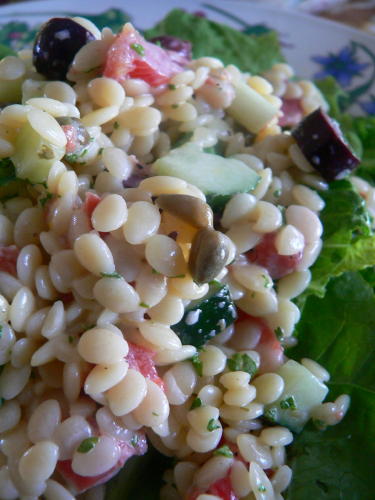
Orzo Salad from Passionate Vegetarian

Dressing:

1/4 cup Vegenaise (or other mayo)
2 tablespoons extra virgin olive oil
1 tablespoon red wine vinegar
juice and zest of half a lemon
2 large pinches dried tarragon
6 threads saffron
2 large pinches dried oregano

Whisk in a bowl.

Prepare 1/2 pound orzo pasta according to package directions. The recipe says chilled but I didn’t bother as all my other ingredients were chilled. I’m also a fan of cool, but not cold, pasta.

Mix-ins:
15 kalamata olives, chopped
2 Roma tomatoes, chopped
1/2 cucumber, unwaxed and unpeeled, chopped
1 rib celery, diced
2 tablespoons minced parsley
salt and freshly ground black pepper to taste

red bell pepper, roasted, peeled, seeded, diced

Romaine leaves, prepared (washed, spun dry, etc.)

Combine dressing, pasta and mix-ins in a bowl. Serve over the romaine leaves.

The recipe suggests topping with smoked tofu or smoked provolone, Parmesan, toasted pine nuts, parsley and mint — you can also use grated Manchego instead. Absolutely delicious.

Monday, October 29, 2007

Fast Food, Obesity's Biggest Culprit

Trend in Fast food Obesity: The Center for Health and Health Care in Schools reports dramatic increase in consumption of fast food by children since 1970. Presently, children get 10 percent of their total energy intake from fast foods, compared to 2 percent in the 1970s.

Since fast food adds 6 pounds per child per year and 33% of the children and teens in the US consume fast food, obesity is on the rise.

Fast food obesity
Fast food obesity

Occurrence of Fast food Obesity: According to a report published in Chicago Tribune, fast-food consumption is more in higher-income households, young boys, older children, African-Americans and children living in the south, whereas fast food consumption is found to be low in youngsters living in the West, rural areas, Hispanics, white women and those aged 4 to 8. Due to the increase in the number of fast food outlets, fast food prevails in virtually every segment of the society, including hospitals and schools, as per a study on fast food & obesity by Harvard School of Public Health.

Relation of fast food to obesity: Fast foods compromise the quality of diet by replacing more healthy foods. Fast foods are known for having high content of saturated and trans-fat, low content of fiber and massive portion sizes, leading to obesity.

Managing Fast food Obesity:
The onus lies on parents to educate their children about the ill effects of fast food. Obesity can be prevented in children by allowing fast food in moderation only. Also, both, the big and small fast food players should educate people about the contents of their products.

Friday, July 13, 2007

Teflon

It is well known that if pots or pans coated with Teflon are left on a stove without any food in them, pet birds living in the kitchen can easily die from the fumes given off. It’s a condition some vets call “Teflon Toxicosis”. It should make us all wonder if these non-stick coatings are harming us.
If Teflon is heated enough it can release up to 6 know toxic chemical, two are known carcinogens. One chemical is an analogue of phosgene, a nerve gas used in WWII.

An organization called the Environmental Working Group has performed independent research on Teflon cook ware, including reviewing research from DuPont and performing their own experiments. Their conclusions were that Teflon coated cookware can emit toxic fumes!
Their advice was that people should try and phase out this type of cookware from their home, especially for bird owners.

If you do want to phase out Teflon pans in your kitchen, what are the alternatives?

• Stainless Steel
Stainless steel is a terrific alternative to a non-stick cooking surface. Most chefs agree that stainless steel browns foods better than non-stick surfaces. In their 2001 review of sauté pans, Cooks Illustrated, an independent publication, chose a stainless steel pan over otherwise identical non-stick models. They also recommended stainless steel pan roasters over non-stick.

• Cast Iron
Cast iron remains a great alternative to non-stick cooking surfaces. Cast iron can be pre-heated to temperatures that will brown meat and will withstand oven temperatures well above what is considered safe for non-stick pans. Cast iron is extremely durable and after being used a few times develops its own non-stick surface.

• Other Cooking Surfaces
Some examples include ceramic titanium and porcelain enamelled cast iron. Both of these surfaces are very durable.


Interesting Facts
  • The EPA has charged DuPont with illegally suppressing Teflon birth defect and water pollution studies for 22 years.
  • Teflon contains a toxic chemical called C8 or PFOA which has been linked to cancer and birth defects in animals. Its effects have never been formally tested on humans
  • Residents of West Virginia and Ohio who are suing DuPont have alleged they are suffering from health problems -- including respiratory problems and cancer -- they attribute to dumping of C-8.
  • DuPont sent a letter to female workers saying that it did not know if there was a relationship between human birth defects and the chemical, but "we think this is a matter of sufficient concern that, as a precaution, a female who has [a blood level] above background level should consult with her personal physician prior to contemplating pregnancy."
    The next year DuPont brought female workers back to areas where C-8 was used.
  • According to the Telegraph in the UK, "The coating on non-stick pans used in millions of kitchens throughout the world has been linked to birth defects in humans and to the deaths of pets."
  • One authority on perfluorinated polymers, Dr Jonathan Martin of Toronto University, said he considered the PFOA in Teflon to be potentially as harmful as the banned perfluorooctane sulphonate.
    "It's not true that risks are less. PFOA has been recognized as a rat carcinogen for decades," he said.

sources:

Blog Widget by LinkWithin